
CRM Integration
CRM Integration
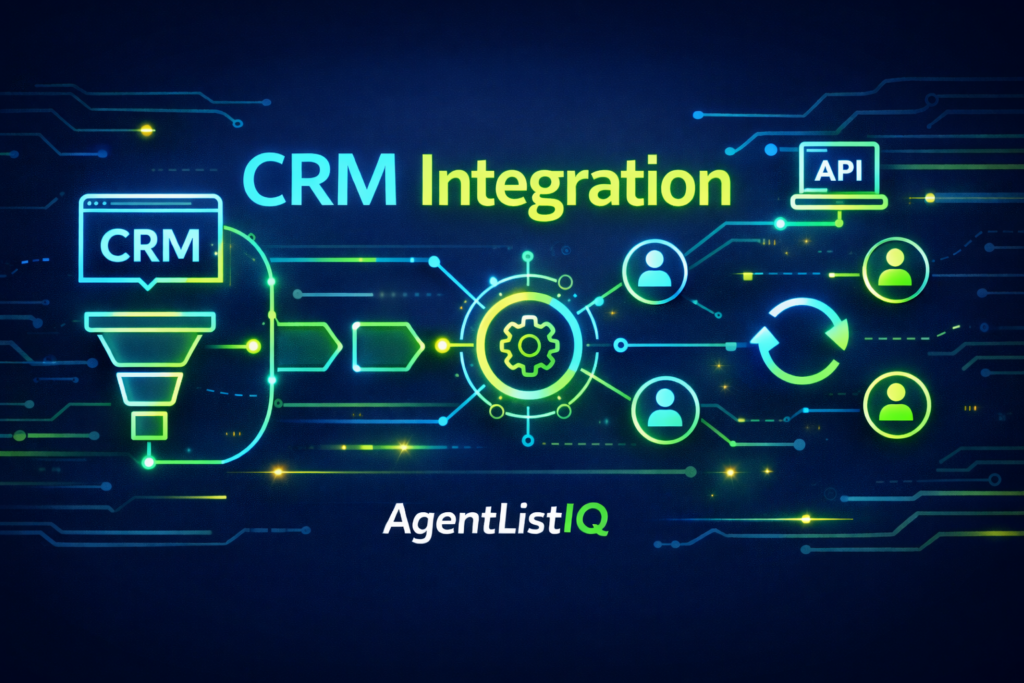
AgentListIQ is built to plug into your existing CRM—not replace it. Most teams already live in a CRM for leads, pipelines, follow-ups, and team accountability. The problem is that pricing work, CMA updates, listing execution, affordability scenarios, and presentation assets often happen outside the CRM—creating drift, duplicate entry, and “what version are we even using?” chaos. AgentListIQ acts as the execution layer that keeps property work synchronized while your CRM stays the command center for relationships and pipeline.
1) Contact + Lead Linking to the Property Object
- Connect CRM contacts/leads to an AgentListIQ property record (your persistent “single source of truth” for the deal).
- Maintain clean mapping: one client → multiple properties, one property → multiple stakeholders (buyer(s), seller(s), lender partner, co-agent, etc.).
- Keep “relationship data” in the CRM, and “property execution data” in AgentListIQ—synchronized, not duplicated.
2) Pipeline Stage Sync (Deal Milestones That Actually Mean Something)
- Map CRM stages (e.g., New Lead → Showing → Offer → Under Contract → Closed) to AgentListIQ milestones.
- When a deal stage changes, AgentListIQ can automatically:
- refresh CMA assumptions,
- generate a new client-ready packet,
- update presentation mode outputs,
- trigger MarketPulse-style update notifications tied to that property workflow.
3) Activity Logging Back to the CRM
- Automatically log key actions as CRM activities/notes, such as:
- CMA created/updated
- listing draft created / write-back completed
- affordability scenario generated
- virtual tour generated
- property packet sent (with timestamp + version)
- Result: the CRM timeline becomes a true audit trail of what was produced and when—without manual note-taking.
4) Document + Presentation Delivery Into CRM Workflows
- Push share links or PDFs (property packets, CMA summaries, tours, seller updates) into:
- CRM email templates,
- texting workflows (where supported),
- deal rooms / transaction checklists (where supported).
- Ensure the CRM always references the latest synced output, reducing “stale attachment” problems.
5) Automation Triggers, Webhooks, and API Connectivity
- Trigger CRM actions from AgentListIQ events:
- “CMA updated due to market change”
- “Comp set changed”
- “Listing status/price changed”
- “Affordability scenario updated”
- Enable integration through:
- secure API endpoints,
- webhooks for real-time event delivery,
- middleware connectors (where applicable) for low-code workflows.
6) Permissions + Brokerage Controls
- Role-based access aligned with brokerage realities:
- agent vs. team lead vs. admin views,
- shared property objects for teams,
- controlled data sharing to the CRM to prevent accidental leakage across teams/branches.
Why it matters
CRMs are typically contact-centric. AgentListIQ is property-centric—and that’s the missing piece for consistent pricing, clean execution, and client-ready presentation without drift. Together, they cover the full reality of a transaction: relationships + execution, synchronized.